Friday, September 13, 2019

My take on ONCE UPON A TIME IN HOLLYWOOD


I am not sure I want to see ONCE UPON A TIME IN HOLLYWOOD, but there is François-Xavier Sauvage’s enthusiastic review on Facebook, and then a fight with my husband. Barricaded behind a small popcorn, I wait. Should have bought a large. Hey, it’s a Tarentino movie, and I am not even wearing a hat to protect myself against the violence
.

But I don’t find the violence in this movie annoying or invasive. It is mostly a spoof of violence.


But I see double. Brad Pitt is the double of Leonardo DeCaprio who, as a fading star, plays in Italian spaghetti westerns, themselves the doubles of American Westerns. The TV Brad and Leonardo watch together is itself a mirror/double of their past glory. The filmed reflect the emotions expressed in reality, making Hollywood a double of reality, but a sanitized double. (The king of Lysol reality or fairytale being, of course, Disney.)


What happens outside the roll of film if stardom cannot be maintained at its peak? What happens to one of the doubles? As DiCaprio’s character shows, nothing but self-destruction. For too long, the star and the roll of film have been one, part of the fairy tale, part of the illusion, here symbolized by Sharon Tate, always beautiful, always happy, (never tragic, never real). To go further DiCaprio’s reality is the roll of film. He is Sharon Tate (who also looks at her double at the movies), full of hope and shine within. Out of the shiny strip of film, he does not exist. What is reality, in fact? And we, the spectators, on the other side of the mirror, watching a movie within a movie? Are we watching ourselves? Are we realizing that reality too is an illusion?


Tarentino appears to enjoy his acrobatics between narrative and ideas, as shows the pace’s fluidity and the way his analysis of Hollywood and the story manage to never disconnect. Intellect and emotion hold hands. And yet, this is a highly watchable movie, highly entertaining and without a dull moment. This parable about Hollywood business and Hollywood narcissistic impact (the constant reflection, double) is also a moving, and at times humorous, drama.


Amidst the splendid cast, I don’t remember when I saw acting as faultless as DiCaprio’s; but watch for ten-year-old Julia Butters, who was part of my two favorite scenes and who has been compared to a young Meryl Streep. Also, pay attention to another powerful scene with Brad Pitt and Bruce Dern.  Dern plays an old friend who is now blind---the significant blind man. Let me paraphrase what a young hippie tells Brad Pitt (/the double/Sancho Panza/the ordinary guy/you and me), afterwards: “It is not him who is blind, it is you who are blind!”


Last time I had a fight with my husband, the movie was delightful. This time, it was a tour de force.


Pierre, where are you? I need a fight!

Friday, October 12, 2018

COLLECTIVE RAPE


Almost from the start, the nomination of Judge Kavanaugh to the Supreme Court felt like a joke. Even when Dr Ford threw herself into the arena, other women had the feeling that the beasts would devour her without giving her a single chance.

And that’s what happened.

To be fair, if Republicans constituted the main part of the monster, partisanship didn’t help. As Dr. Ford re-lived her pain in public, she was exploited by senators for political ends. To both parties, she was little more than a thing, a key for the upcoming elections.

As other women victims of sexual abuse offered their help and testimonies to the senate, only to be ignored and rejected, another solution was presented, that of an investigation by the FBI on the accused, Judge Kavanaugh. But the executive made sure to place clear conditions for this investigation: it would last no longer than a week and only a few people would be interrogated.

The FBI is our national police. Is that a way a criminal investigation is lead? Do the police tell its detectives to finish their investigation in a limited amount of time, and to interrogate only a precise list of persons? Is that how crimes are solved? In just a few days, can strong suspicions of attempted rape suddenly become moral compass?

Can a man with a blurry past and a questionable ability to control his temper (Kavanaugh’s display of anger as he defended himself on the senate floor) be crowned as judge of the Supreme Court of the United States of America?

Apparently, yes to all these questions.

The outcome of the US Senate proceedings, the FBI joke of an investigation included, failed to surprise many of us women. After all, quite of few of us have been abused: sexually, physically, psychologically, take your pick or check the data.  

This time, it felt like a collective rape.

Saturday, June 2, 2018

HOW A CAN OF WD-40 MADE A CLASSICAL GUITAR BEHAVE


When it comes to owning a guitar, the difference between having an acoustic one and a classical one is like having an easy-going Saint Bernard and a capricious French poodle. When a string breaks on an acoustic guitar, you just have to change it, plus you’ve got a bridge pin that pretty much takes care of one end. When that string is replaced and tuned up, your fingers can glide along, as your acoustic guitar is basically saying, “Cool, man!” Now you know who the comfy St Bernard is.

Now, for the classical little bitch. You want to get away with changing one string, but the other strings yell, “Me too! Me too!” And they’re not talking about revolution. Remember, they’re classical. They’re like duchesses wanting new dresses for their special soiree. So you end up changing every fucking string! And you’ve got to handle both ends. And there is no bridge pin to help you here. So if you don’t tie up your string properly, the string is going to fly into your face, and the duchess is going to exclaim, “Oh, dear! Oh, dear!” At this point, you may be screaming other stuff that may only be intelligible to extra-terrestrials, stuff life, “##@@uFUckIng@$%CuNt@i$VaNA@i’BEtu’REfuCkING$#&DaDdy☻☻☺$$$!!!”

 But finally, finally! You’re almost done. You’re basically tuned up. Except for the low E. That duchess won’t go further than C. You try, you cajole, but the arthritic bitch won’t budge
 That’s when you go to the garage, grab your DW-40 can and tell that duchess, “Now, here’s a new beauty line that you’re going to love!” And after a few drops and a few turns, everything gets back into e/motion.

Wednesday, April 11, 2018

OUR BELOVED DICTATORS


 Let’s admit it, we love dictators.

We love Mussolini.
 We love Napoleon.
 We love Pinochet.

No? You disagree?

You believe that, in a country like ours, they should be thrown overboard, and in a jiffy, p-l-e-a-s-e?

 True, the frame of this entire nation, what sustains it, what articulates its flesh is liberty.  And this, despite the initial crimes that were committed against Native Americans and African Americans. We’ve got our own apartheid, our own holocaust, which we should claim . Why? Because we must not forget, for one. But also because it is upon these abuses that we learned and were able to construct the most sophisticated democracy on earth. Granted, it makes liberty quite expensive, and democracy far more precious than priceless stones like The Sancy Diamond. But that’s the way it should be. What we have is not to be taken for granted, and the American Constitution, with its system of carefully orchestrated check and balances, is not as infallible as we thought it once was, but only as solid and honest as the lawmakers who handle it.

  Democracy, in order to survive, must reinvent itself, as society evolves. It does so by amending old laws, creating new ones, establishing new rights. Rights of women, of gays and transgender people. The rights of Blacks and Latinos. The rights of Natives and Mother Earth. So democracy is that organic matter, that stream that un-pollutes itself, that manuscript in constant search for “le most juste”— for just action. It is not a finished work, nor should it ever become one.

 Were it so—finished and square, with a wall, no horizon—it would no longer look like itself.
 Finished, it would be, indeed, finished. A dictatorship.

 Democracy can be, in fact, chaotic at times, albeit capable of offering prosperity and stability. When good economics and low unemployment are part of the landscape, when the middle class spreads wide like a solid foundation, we don’t mind the occasional chaos, for that goes with liberty. But when the economy crumbles, when the job market locks up and poverty increases; when the wealth distribution is so uneven that the middle class keeps shrinking at an alarming pace, stability disappears and chaos is as dizzying as a disease.

 Scraping the bottom of the barrel, workers are wondering how they are going to pay their bills. Cancer patients are asking themselves if they will have to cut their pills in half again in order to be able to reach the end of the month.

 In what used to be the wealthiest nation, Americans feel now weakened, unprotected.

 Whose fault? Democrats’? Republicans’?

 Or just Congress, either party, filling their pocket and bowing to high interests, while forgetting that children will  go hungry at home, waiting  impatiently until the next morning, when they will be fed at school the only meal of the day?

 If democracy needs a diversity of parties and p.o.v., corruption does not discriminate. It is all embracing. And in the past ten-fifteen years, it appears that corruption has been far more active than democracy. Had the reverse been true, chances are the aforementioned economic situation wouldn’t have occurred at such a profound level.

 In other words, our congress grew corrupt and lazy as our country grew fragile and desperate.

 Knees were so weak when he arrived. The knees of our county. Our knees.

 But when we saw him, so loud, so strong, we welcomed him with open arms.

 We would grow strong too.

 We had seen his name time and again on gigantic towers.

 A gigantic name on a gigantic tower. TRUMP. Even his name looked like a tower.


He promised order. Order. And a great big wall.

 There he was, a loud mouth, for sure, with a bad temper, just like daddy. But that was character, that’s what it was. Character.

 And he talked like the rest of us. A man so rich who talked like simple people. That meant we could get rich too.

 So what if he was if he was connected to the Russians, or to the mafia?

 He would protect us.

 So what if he was a bit of a dictator at times? So what if he had the Sinclair Broadcast Group force its 137 stations spread propaganda about him all across the nation? He had his heart in the right place. He cared about us.

 Right?

 Right?

 These were rough times and he was the right man for the moment. He would fix things.
 He would.

 Come to think of it, Hitler came soon after that huge 1929 economic crisis. That’s what got him elected. He would fix things too.

Thursday, July 27, 2017

We forget

I forget?

With all the daily political drama, and all the fight with the local group of Indivisible, I forget. I forget that I am an individual too. With specific talents and, possibly, a mission.

I forget this incessant Trumpian drama is but an interruption, that this frustration, this anger will eventually stop. Because this regime will stop.

I forget that I can resume what I love to do. Write. And today, I got a reminder.

Once in a while (often in dark moments when I tell myself my steps on the writing page are useless and insignificant), I get messages of people telling me that some people like my reviews. I am always happily surprised when I see this. The joy is comparable to people enjoying my books. Writing is writing is writing. It tells me that people are reading and are reading readers, searching and thinking. A good sign.

Today, I was all the more surprised that two readers liked a review of a book that had completely gone out of my mind. A book of essays with a great title, actually, The War Against Clichés by Martin Amis.

Yes, we do forget. A dangerous thing, forgetting ourselves. A good thing there are those around us to remind us.

Thursday, May 4, 2017

WHY THE FRENCH ELECTIONS THIS COMING SUNDAY COULD AFFECT US ALL

France is not the first power in the world. Or the second, or the third. It ranks 6th among powerful nations these days. And yet, with the upcoming presidential elections, it could become the center of the world again. In other words, France’s elections this coming Sunday could affect us all. Here’s how:

If fascist Marine LePen gets elected, she will want out of Europe. Add that to the Brexit, and the entire Europe crumbles, as it was founded on/by the German-UK-France axis. The concept of Europe, besides economical, is a pacifist one. It was built so that something like WWI or WWII would never happen again.

With Europe gone, nationalisms (fascisms) are awakened. Tensions develop. Wars become imminent.
Who profits from this? Russia, of course, who can invade the now divided nations, economically like the Chinese are doing in Africa, or militarily. Or both. Resistance would build, no doubt, in many parts. The US would want to intervene. So would the Chinese. They wouldn’t want their piece of the cake to be eaten. Another World War could begin.

If Emmanuel Macron is elected, Europe will go on. Balance, if precarious, will be worked on and eventually solidified. It all depends on one vote. One vote.

Les Français, on compte sur vous. Pas de conneries!

Saturday, January 28, 2017

LIT AND POLITICS


After reading a few disappointing novels, I decided to go with John Irving's The Hotel New Hampshire for a good dose of literature with beautiful prose, and Stephen King's Mr Mercedes. I knew I had two masters in my hand. And I was curious to know how King would do with the mystery genre. What I was sure of was that I wouldn't be disappointed.

Right?

King, after all, can build a sentence. And Mr Mercedes is the winner of the 2015 Edgar Award for Best Novel. So, damnit, I was all set.

What I didn't suspect (although I was reading a mystery) was that I was having one of my---rare, but still present---naivety seizures. But I did wake up. Took 50 pages, though.

Those same pages that the critics from major publications bother to read, I assume. Otherwise, there would be no positive feedback. And the only pages that King wrote, I suspect. I had similar experiences with Grisham. Not the early Grisham. The well established Grisham.

Well, the well established King seems to have imitated his colleague. Oh, I was quite thrilled by Mr Mercedes' beginning, even if I thought that the slang there was a bit overdone.

But after aforementioned pages, everything stagnates. The psychological insights of the murderer, promising at first, go in circles. The incest theme is just there to titillate. Still, I yawn instead, No one who has fallen in love will believe in the love story there. The eroticism and sentiments feel like overcooked noodles. And this silly sleepover is the motivation of the retired cop to find the killer? P-leeease!

Toward the end, there is some action that grabs some interest. Did King edit the mediocre ghost writer? Did some smart editor? But it is too late. It makes the novel all the more uneven.

In conclusion, Mr Mercedes is basically an ode to mediocrity. In other words, a piece of crap. So here is my message to Stephen King, John Grisham and the like. Don't become just a brand! There are writers like me who love words, who work their ass out to produce serious, thoughtout work, so let us share it. What you do isn't fair to the reader; it isn't fair to us. You're just playing politics. Literature and politics make for a bitter, undigestible sauce. So why don't you move the hell over?

Wednesday, September 9, 2015

ABANDONMENTS


Three.

Three major abandonments in my life. I reflected on that, this past Sunday at 1 p.m, as I finally sat down to get some breakfast.

3. Three. (Take your pick. The number. The feelings. The blades.)

My best friend.

My family.

My other best friend.

Not necessarily in that chronological order.

But certainly in that emotional order.

I didn't realize as a child that I was abandoned by my family. I just thought I didn't fit the mold. That's why they didn't love me the way they loved each other. It's only later, when I fell in love, when love became a frightening thing, that I realized I didn't know what love was. For years I had to grow accustomed to it. To this day, love still frightens me from time to time.

In my teenage years, I found something magical. A beautiful, profound friendship. We could remain silent for hours, watching the river run in the summer, the flames crackle and rise in the fireplace in the winter. We knew a cozy conversation existed within that silence. Our parents thought we were weird. We didn't give a damn. Our silences lingered. Until that summer. She was sixteen and it was a Sunday. I had just returned from Spain. Spanish boys had taught me how to French kiss. I was going to tell her all about it. I was going to meet her after lunch, but a car beat me to it, hitting her moped in the bright, Basque sun. Christine was sixteen. She would never grow old; she would never French kiss a boy. That summer, I learned about pleasure and death.

When I promised myself never to open my heart to another best friend, was I right?  "Beware of your first movements, as they are the right ones," said Talleyrand. I had to take an antidepressant when I lost Christine. My wounded heart had locked its doors. But this new girl kept knocking with her smiles and her enthusiasm. Her sense that life could be fun. She made me see bright colors again. So little by little the doors of my heart opened up and she became my new best friend. She did prove herself worthy of the name. She and her family did everything they could to help me cross the Atlantic with the man I loved (and to whom I am still married after 37 years), despite terrible threats made by my mother.

Almost three decades went by. I kept seeing her as my best friend. So much so that I crossed the Atlantic (the other way this time) when I sensed she was too depressed to handle life on her own. That’s when things began to decay. Or, rather, that’s when the decay started to show. She first presented me to her yoga students as her "best friend," then just as "a friend."  A friend who had flown to France because she was worried about "a friend." Later, she sent a birthday present to my husband but my own birthday was nearly forgotten. There was a distracted wish, no gift. For too many years, I had failed to notice that, when she called and I picked up the phone, she insisted on talking to my husband afterwards. When he picked up the phone, she was satisfied. There was no need to hear my voice.

A couple of nights ago, I dreamed of broken dishes.

I am surprised I can still stand up when all within me feels so scattered and broken at the base.

Tuesday, September 1, 2015

THE DONALD

When my daughter and I were on the phone today, she told me she had almost finished reading my novel, "Was Donald Chancecastle modeled after Donald Trump?" she asked.

Smart woman. When I created the pompous, noisy character, I did have The Donald in mind. I thought about changing the first name. But, considering the satiric characteristics of the novel, I kept it. For if there is some grandiloquence in "Donald," you will also find quirky comedy there as well. Think "Donald Duck."

And, to top it all, Donald Chancecastle is kinky.

Little did I know that he would come out when The Donald would make such an apparition in the news.

Of course, no one in their right mind would vote for Donald Chancecastle.

Friday, August 28, 2015

ANATOMY OF A TITLE


I wrote From A to Zoe before I wrote Chainsaw Jane. Why it got out now, and not before CJ? I didn’t have a title. Or I had too many titles, take your pick. For years, I convinced myself the titling issue was the reason. Yup, for years—no kidding—I tortured my little mind with title possibilities. Made one list, then another. Threw them in the basket or forgot about them. Began a title list again. Abandoned it once more. For a long time the novel was called And So It Starts Again. After all, Zoe, the narrator, was making tabula rasa of her old life and beginning again. There was an irony in that title that I kinda liked: Zoe is convinced her new life will go smoothly, with no single bump on the road. And guess what? She falls on her ass at every turn.

I tried that title on people. No reaction.

At one point I considered No Mozzarella for Me. The title stood on the manuscript first page for longer than a few minutes. Months went by and it was still there. Was that the one? Once you read the novel, you will understand why this cheesy option was a serious candidate. There is a rat there who will only eat Swiss cheese. The only way he will bite into mozzarella is when he realizes the other alternative is starvation. And of course, the title also suggested that Zoe wanted a more flavorful bite of life—that life should be relished.

I tried that title on people. No reaction.

Some members in my writing group thought that just Zoe would be plenty of title. Zoe, after all, means life. Zoe and zoo have the same origin, and in this novel, animals actually play a major role. And the Brooklyn Zoo does play a role as well. I liked the concept. Still, I felt it was missing something. But what, exactly?

To an author, the choice of a title is a way to direct the reader toward her way of thinking. It is, from the very beginning, an invitation into her world. She’s getting her house ready for the guests. The title is the central bouquet at the banquet table. Without imposing a way of thinking to the reader (without imposing a topic of conversation to the guest), the author is setting a tone.

Well, I didn’t have my tone set, I didn’t have my bouquet, I didn’t have my title, dammit!

So I went back to cogitating on Zoe. I knew the central theme, of course. But I also knew it was a tragicomedy narrated by a sassy yet vulnerable woman; someone who fell, nearly collapsed, but found somewhere some indomitable courage to get up once more. Someone who used bite, humor, satire as surviving tools. I never had much trouble with a title before. With Chainsaw Jane, the reverse happened. I had a title; I needed to find a story to go with it.

Finally, I had a couple of serious contenders. That was during one of my trips to Denver, when I visited my daughter. One of them was From A to Zoe. This one seemed to be appealing to other people besides myself, including my daughters’s husband (at the time her fiancé).

Finally, a reaction, and a positive one at that.

Finally, the banquet’s bouquet.

Soon after, I was ready to let From A to Zoe go, meet the world. I kept asking myself why it took so long. But then it struck me and it struck me harder than before: Zoe is the story of a woman who starts all over again.

This past summer, I put my house for sale. I will sell all my furniture, take my husband and my pets with me, and leave. I will start all over again. Learn the basics again.

And, I suspect, fall on my ass again. But like Zoe, I’ve got expertise in that field as well.

Whoever started saying there was no coincidence might have been on to something.

http://www.amazon.com/Zoe-Novel-Marie-Jo-Fortis-ebook/dp/B012UQUWXQ

Wednesday, February 4, 2015

Yeah, yeah, it has been a while.

I finished writing my novel About Emily. I went through a couple of revisions, gave it to read to Pierre as well. I am very proud of this work, even if it is quite different from what I have done recently. It does not insist on humor, satire, and there is very little levity anywhere there. The plot came to me in a dream. All I had to do was write it.

All I had to do. Give my soul to it. Sell my soul. That's how it felt like, basically. For when I completed Emily, I felt drained inside.

Drained, and proud.

But I feel proud at the completion of every novel I write. Every time, I feel this is the best writing I have ever done. Emily is no exception. The only difference is that, unlike Chainsaw Jane and From A to Zoe (which I am going to put on the market shortly, hopefully), this is literary work, not the type of writing that will attract the masses. Prose, style, inner wanderings are more important than action here. Paris is as much a character as, well, characters.

At the same time, I fear disappointment. Is it as good as I think it is? How can I know? Sales? Sales do sometimes---but not necessarily---indicate the quality of a work. If I keep being an independent author, I will need luck on my side, as I can put so much money on marketing. But I am getting ahead of myself. The book is not ready for publication. It's just a newborn.

Time. Time will let me know, independent of sales. Once I get detached from all the efforts placed into Emily, and once I get back to reading it again with my left brain---all blades of my critical mind sharpened---I will know.

Meanwhile, there is that feeling of delivering a newborn. It's exhilarating, exhausting, and for a while you don't know where your mind is. And yet you don't want to go anywhere else.

Tuesday, December 9, 2014

SOMETIMES, HUSBANDS SHOULD LISTEN TO THEIR WIVES, I'M JUST SAYIN'

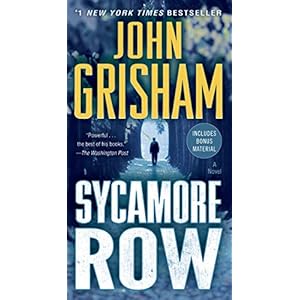
Sycamore Row: A Novel (Jake Brigance Book 2)Grisham is back! Really? That’s what I wanted to believe as well. At first, Sycamore Row is full of atmosphere: the southern little town, the colorful waitress, the flavorful dialogues. So I am happy to find Grisham again, and with a humor bonus on top of that, at least at first. Not that he is humorless in other works, but here the rural settings seem to stimulate his wit and sass, despite the morbid start of the novel and its important topic.
    We are in the 1980's, in a Mississippi little town where the sheriff and one of the judges tend to stretch the law one way or the other, and where racism has far from disappeared. Readers who know Grisham well have visited the place already, and met most characters in A Time to Kill, Grisham’s first novel. Here, a black woman is about to inherit millions from a white man at the expense of his family. Some issues arise from this. The duty to one’s family is one. A significant anti-racist statement is another. You could add this: the freedom to do what one wants with one’s own fortune. What is more important in life—the personal or the civic? What if the personal and the historic were one and the same?

    All these problems are posed, somewhat addressed, never really explored.

    Too bad. Sycamore Row could have been fascinating, the stuff of great literature, with such a title, too! But if it is gripping in the beginning and interesting in the end, what it is in the middle is too much like small towns and not enough like good writing: so dull and soporific that you want to get drunk with Lucien—the alcoholic and debarred lawyer of the novel.

    At the end of each one of his novels, Grisham usually addresses his readers, evoking the epopee of the writing of that particular book. Here, he tells us that his wife Renée, “was not too keen on a sequel” of A Time to Kill, which many readers consider his masterpiece.

    Renée, I believe you were right.

Wednesday, October 29, 2014

SO PISSED, PART 2--- THE GOLDFINCH by Donna Tartt-- MY REVIEW

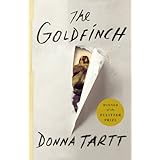
Product DetailsWere the members of the Pulitzer Board on acid when they decided that The Goldfinch would get the crown? And didn’t they notice its editor must have been on strike—or smoking weed while relaxing under a tree? Who knows, they all might have been inspired by Theo, the novel’s narrator, a poster boy for addiction who swallows pills like M&M’s.

And, actually, this novel is pretty much like a box of chocolates. You begin with the few good ones and then...

When I picked up the work and was informed that Donna Tartt spent ten years writing it, I imagined a Flaubertian author seeking “le mot juste.” And if there are moments when the work clicks, when psychological tension happens, when dream/nightmare and reality blend, there is also that moment when I wonder if the ten-year-writing story is not some publicity stunt. Some brainwashing, as some of the writing here is totally loose, adolescent and careless. My suspicions arise somewhat at the museum scene, when all collapses, including Tartt’s prose which drags on and on and on...And on...

But it begins so well! Is that howTartt got the Pulitzer—on the first 50 pages of reading? It is undeniable that she’s a capable writer. But at some point, something happened. She either went into some kind of depression or into some substance dependency. To the point where you stop caring for the narrator, for he ends up deconstructing himself, becoming (un-becoming) a character with no character.

As for the characters that truly deserve care and attention, Tartt turns her back to them. Say, Andy, Theo’s genius little friend who seems as emotionally estranged from his own family as he is from his own emotions; Andy is such an intriguing character. What does Tartt do? Without revealing the plot, I’ll just say that she does next to nothing with that. There are points of reference here and there, and now and then, but these are but tiny grains of sugar in very troubled water. And why does she insist on Boris, a horrible, incoherent character, more animal than human, more rat than dog in his invasiveness? I honestly detest this personage, who manages to be at once ugly, boring, confusing, and cliched. The only way I would like him is if he were sculpted by pastry chefs on the Halloween Wars show on the Cooking Channel.

Are there interesting characters? Mrs Barbour is one of the better ones. Mom could have been fabulous, but is not there long enough. Hobbie and Pippa are just fairy tale decorations. Had Tatt concentrated her efforts on Andy, Mom, Mrs Barbour and done something with Hobbie, she might have deserved that Pulitzer. Instead, she makes us spend time with the wrong people. Instead, she adds others—bim, bam, boom!— who pop out like mushrooms—fungus—after a two-week rain. Instead, she lets her verbal self indulgence get the better of herself. (Again, where was the editor? Snoring in a corner?) As for the flooding, pseudo-philosophical verbosity of the end, it is a total, total disaster.

In the end, The Goldfinch relentlessly kills what it could have been. It’s a novel that tries to keep going despite the fact that soon in the plot it slices its own veins.       

SO PISSED!

I thought the pissing would go away, but three days after finishing Donna Tartt's The Goldfinch, the flow has actually increased. I am ready to pull out the pages of the book, one by one, and throw them in the Clarion River. A good thing I've got a kindle, so disaster can be avoided. But this---THIS got the Pulitzer??? This is literature?

What this does is reflect perfectly what has been happening in the world of publication in the past few years. Total chaos---the basic confirmation of what a literary agent once told me at a conference. Even at the literary end of large publishing companies, they are so eager to blend in sensationalism and commercialism they come up with a mix that is not only unsavory, but total garbage. And then, politics come in. The results: they give garbage the Pulitzer.

So my humble advise to writers out there. Keep writing only if you are convinced writing is part of your heartbeat, your oxygen.

When you do, kill self-indulgence (The Godfinch is full of it) and "revise, revise, revise! "

Friday, April 25, 2014

BETWEEN MONSTER AND BIRTH

Rebecca by Daphne du Maurier --- my view

DaphneDuMaurier Rebecca first.jpgIf you’re afraid of going back to the classics because you like page turners, don’t be! At least not with Rebecca. I revisited the novel for pace reasons. Let me explain. I am working on a literary mystery and I was in need of some inspiration and sustenance not so much for plot as for rhythm and tension. Rebecca, the forerunner of the psychological thriller, happened to be the perfect choice. Of course, I mixed business with pleasure for the novel is, as mentioned before, vastly entertaining. Something Du Maurier wanted. With time, it acquired a lot more than commercial value and became quite an important literary work.
With its remarkable descriptions of nature—either friendly or threatening—or of Manderley, a mansion that our unnamed narrator never controls or owns, this work is, besides a damn good story, all allegory, all metaphor.
I found pleasure turning those pages, but it was a sad, depressed pleasure. Don’t be fooled by the entertaining qualities of the novel, for this is a profoundly dark work. Entering Manderley felt like entering a grave. Our unnamed narrator never quite existed. (Her descriptions relate to her absence rather than her presence.) She died before being born. She never asserted herself, letting fear and the glance of others control her. And dead Rebecca was always like the sea, renewing her ardor with each wave.
This is not an easy work. For no matter how pale or submissive the narrator seems to be, the reader roots for her. Who doesn’t have compassion for a victim? And she’s attacked on all fronts. On one side, she has to please her husband, be a dreamer, “Alice in Wonderland,” as he puts it. On the other, she is given the chance to shine, be another Rebecca. None of these choices will make her happy. Being a husband pleaser will kill her identity. Being a rebel will make her true to herself but unacceptable to society. Unless she becomes some sort of monster, like Rebecca, playing the societal game on one side and not caring about anyone on the other. In the end, we know what she chooses. We know the tragedy.
And we know why this complex work is indeed a classic.

AESTHETES DO NOT NEED TO BE HERMIT CRABS

L'Élégance du hérisson (The Elegance of the Hedgehog) by Muriel Babery ---my view


This a closed spaced —locked?— novel almost to the end, as everything happens indoors—physically and metaphorically speaking. When the door of the building is pushed at last and Paris shows its face, then it’s all over. Tragedy strikes. At least tragedy in its most manifest, albeit ordinary, form. For this is not a happy novel, although the possibility of redemption, or at least hope, appears. Destinies are retraced. What one pre-adolescent thought she understood and controlled ends up being not so controllable or understandable after all. Suicide might not be the solution. Life is not such a simple formula. What the intellect grasps, the emotions swallow and spurt out, but not very neatly. What ideas collect and put in place, art rearranges and deranges in the process.
Muriel Babery sets her philosophical novel in a Paris building for the rich and spoiled. Two rebels against the system are the voices of this novel—Renée, the concierge, and Paloma, a gifted twelve-year old who thinks life is not worth living. Their rebellion is an inner rebellion, and the building in which all this (non)action takes place can be seen not only as a metaphor for their inner life, but also for the suffocating society that surrounds them. Only books, only literature can open up such a space, reinvent such a space. Only minds like them can now enter this reinvented place. A cat will be allowed as well. And, later, a Japanese man with his new perspective on things.
  Babery, in this slow paced, intellectual and poetic work, depicts two refined souls in a brutal world, two strangers with a hermit crab attitude trying desperately to protect themselves from the adventure of life. Until one shell starts to open and the other, as a consequence, has to break, so life, because of death, must be lived. This sounds cryptic. But when you read this intriguing novel, you will understand.
It is not a perfect work; there are some dead moments, although rare. Some chapters could have been removed; others, developed. Some useless characters could have been killed. Some vigor in the thought process could have been added. But Barbery still achieved something quite remarkable with this novel: in an elegant, highly accessible prose, she did manage to intrigue and stimulate both sides of the brain. High marks for that.

Wednesday, April 23, 2014

IS MRI A LIGHTLESS TUNNEL?

So once upon a time (okay a couple of days ago) a person with a mild case of claustrophobia had to go through an MRI. Personnel at the hospital failed to reassure her. The MRI operator told her he couldn’t stand the thing himself without tranquilizers. So with the help of all this comforting and her own writer’s imagination, she swallowed a couple of pills before entering hell on earth, that dark, airless tunnel that would attack her from all sides. The day came, the moment. A half-spheric glass shape was placed above her head. Great. Now, she looked like a robot. A button was pushed and she glided into a tube, the tube. And then, what? It stopped and she could actually see the light at the end of the tunnel. Literally. And there was plenty of air circulating around her. She said: “That’s it? That’s what I am supposed to be afraid of? That’s why I got myself spaced out for?”

P..S. Okay, Mr MRI has some sort of temper and makes funny noises, some actually sounding like machine guns, so I would recommend MRI’s to crime fiction authors mostly, and only if they are not on vacation at the moment.

Friday, March 21, 2014

PROFESSIONAL EDITORS NOW MORE THAN EVER

In this new age of publication, where indie authors are given more attention than ever, professional editors should not be neglected. Au contraire. My review of Origins by Eric Drouant illustrates this point. Indie authors, no matter how talented, should remember that even the most successful writers are edited by pros.

I bought this book because I was intrigued by the premise, that is how the US government, with a mad man in its midst, plans to use Cassie and Ronnie, two thirteen year olds gifted with psychic abilities. The occasional spelling and punctuation typos put aside, the structure of the novel could have gained power with additional revisions. Even if this is the first of a series where Drouant needs to introduce his characters, it takes a long time for the plot to really start. Had the novel begun with a slightly reworked Chapter 6, when the kids flee their respective home, the action would have picked up immediately, and all of what the reader needed to know about the gifted kids could have been given through informative flashbacks. Instead, a good part of the first half of Origins contains dead or repetitious moments. After that, and as soon as the police and the press enter the scene, the pace changes, even the style changes. Although following the same teenagers, it almost feels like a different novel. Frankly, that second half is where the thriller part happens. That’s where a professional editor could have helped and that’s why I can only give three stars to this novel, because only half of it is good.

Monday, March 10, 2014

SIMONE AT THE GATE


SISSI (aka Simone): “What’s this? Some kind of barricade?”

MOM: “A border. You need to get a passport to cross it.”

SISSI: “Oh, yeah?”

MOM: “Some part of the population cannot go through, though.”

SISSI: “Such as?”

MOM: “Terrorists. And I mean a specific type of terrorists. The ones who enjoy terrorizing cats. Creature who like chocolate. And I mean a specific type of chocolate. Cat poop, for example.”

SISSI: “Oh, damn!”

Silence.

SISSI: “There is another border on the other side.”

MOM: “Yeah.”

SISSI: “But that’s Coco’s (aka Colette) special bathroom over there!”

MOM: “You mean, what I and other people around here call the den.”

TO BE FOLLOWED....


COCO: “Well, well, well. It seems my special bathroom is not accessible to me these days. Ha! See if I care! I’ve got my own special chair and my own special fire.”


Wednesday, March 5, 2014

Writing Companion

I have a writing companion. He likes to travel on my lap when I write. At the moment, he’s perched on my arm and examining the laptop screen. His name is Beckett (yes, named after the great Sam). When he climbs on my shoulder, he likes to inspect my ears, or grab a piece of my hair and meticulously remove any sort of particle he may find there. Our internal dialogue goes approximately like this:

    “Hey,” I tell him, “it’s clean.”
    “Oh, yeah, how often do you wash your hair?”
    “Every other day.”
    “You dirtball! Do you see how often I wash mine? Like every hour or so?”
    “Those are feathers, you brat! You’re a damn parrot!”
    “I am cleaner than you are! I am cleaner than you are!”
    “Oh, yeah? Who just pooped on my pants!”
    “At least I didn’t poop in...”
    “Oh, shut up!”
    “Okay, I’ll just go back and clean your hair. When will you learn?”