In this new age of publication, where indie authors are given more attention than ever, professional editors should not be neglected. Au contraire. My review of Origins by Eric Drouant illustrates this point. Indie authors, no matter how talented, should remember that even the most successful writers are edited by pros.
I bought this book because I was intrigued by the premise, that is how the US government, with a mad man in its midst, plans to use Cassie and Ronnie, two thirteen year olds gifted with psychic abilities. The occasional spelling and punctuation typos put aside, the structure of the novel could have gained power with additional revisions. Even if this is the first of a series where Drouant needs to introduce his characters, it takes a long time for the plot to really start. Had the novel begun with a slightly reworked Chapter 6, when the kids flee their respective home, the action would have picked up immediately, and all of what the reader needed to know about the gifted kids could have been given through informative flashbacks. Instead, a good part of the first half of Origins contains dead or repetitious moments. After that, and as soon as the police and the press enter the scene, the pace changes, even the style changes. Although following the same teenagers, it almost feels like a different novel. Frankly, that second half is where the thriller part happens. That’s where a professional editor could have helped and that’s why I can only give three stars to this novel, because only half of it is good.
Friday, March 21, 2014

Monday, March 10, 2014
SIMONE AT THE GATE

SISSI (aka Simone): “What’s this? Some kind of barricade?”
MOM: “A border. You need to get a passport to cross it.”
SISSI: “Oh, yeah?”
MOM: “Some part of the population cannot go through, though.”
SISSI: “Such as?”
MOM: “Terrorists. And I mean a specific type of terrorists. The ones who enjoy terrorizing cats. Creature who like chocolate. And I mean a specific type of chocolate. Cat poop, for example.”
SISSI: “Oh, damn!”
Silence.
SISSI: “There is another border on the other side.”
MOM: “Yeah.”
SISSI: “But that’s Coco’s (aka Colette) special bathroom over there!”
MOM: “You mean, what I and other people around here call the den.”
TO BE FOLLOWED....

COCO: “Well, well, well. It seems my special bathroom is not accessible to me these days. Ha! See if I care! I’ve got my own special chair and my own special fire.”
Wednesday, March 5, 2014
Writing Companion
I have a writing companion. He likes to travel on my lap when I write. At the moment, he’s perched on my arm and examining the laptop screen. His name is Beckett (yes, named after the great Sam). When he climbs on my shoulder, he likes to inspect my ears, or grab a piece of my hair and meticulously remove any sort of particle he may find there. Our internal dialogue goes approximately like this:
“Hey,” I tell him, “it’s clean.”
“Oh, yeah, how often do you wash your hair?”
“Every other day.”
“You dirtball! Do you see how often I wash mine? Like every hour or so?”
“Those are feathers, you brat! You’re a damn parrot!”
“I am cleaner than you are! I am cleaner than you are!”
“Oh, yeah? Who just pooped on my pants!”
“At least I didn’t poop in...”
“Oh, shut up!”
“Okay, I’ll just go back and clean your hair. When will you learn?”
“Hey,” I tell him, “it’s clean.”
“Oh, yeah, how often do you wash your hair?”
“Every other day.”
“You dirtball! Do you see how often I wash mine? Like every hour or so?”
“Those are feathers, you brat! You’re a damn parrot!”
“I am cleaner than you are! I am cleaner than you are!”
“Oh, yeah? Who just pooped on my pants!”
“At least I didn’t poop in...”
“Oh, shut up!”
“Okay, I’ll just go back and clean your hair. When will you learn?”
Monday, February 24, 2014
ENTERING THE LONELINESS OF A HOPPER PAINTING
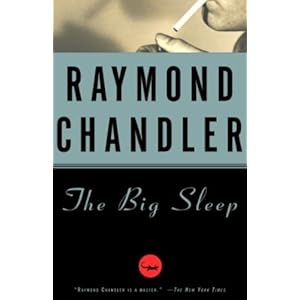 THE BIG SLEEP is Chandler’s first novel and this is my Chandler’s first read. So I’ll tell you what strikes first: it’s Chandler’s writing style, the ironic voice of private detective Philip Marlowe, a man who drinks too much, smokes too much and, we suspect, uses smoke and drink to hide personal wounds. The man is as much a mystery as the plot itself which, in places, gets messy and overcharged. What draws the reader to this novel, besides the style and voice, is the atmospheric charm of the descriptions. It’s hard to imagine so much rain in Los Angeles. But Chandler makes his suspension of disbelief effective. Besides, the rain may stand for something else. As does the wealthy family he works for, in ruins. There is a social commentary subtext here. Perhaps not so much of a subtext as a theme as Chandler associates decay with the City of Angels. At times, you feel as if you are entering the lonesomeness of a Hopper painting (think "Nighthawks"). And it may be why Chandler is part of literature.
Monday, January 20, 2014
NO LONGER A TOM CLANCY VIRGIN BUT...
No, I didn't misspell the title. It's "but" with one "t." He had written bestsellers that were at the same time political thrillers. So, why not, even if I don't always go for the obvious choice. But I do enjoy a good thriller and a good political conflict as well. Clancy was a conservative; I lean toward the left. And by that I don't mean I am a Democrat, which is just the left wing of a political system that has bent way, way to the right and keeps going further from the center. This said, when it comes to creative writing, I don't care what party an author belongs to as long as he or she produces at the very least good prose, identifiable characters and a solid plot. Without Remorse, the Clancy novel I had in my hands, began with a strong narrative, so I carried on...for a while. But then it began to become macho fiction or, as one amazon.com reviewer pointed out, writing for "dudes," with an orgy of details about boat mechanics, drone and missile operations, and a simplistic view of women. If you want to see a guy fall in love with a prostitute in a jiffy, just watch Pretty Woman; don't read this absurd subplot. And the cartoon doesn't stop here: the pretty woman is fragile; the one with a doctorate in pharmacy had absolutely no sex appeal. So losing my virginity to Clancy hurt somewhat, but at least I am now ready to fall in love with someone else.
Tuesday, November 26, 2013
No More Black Fridays
I used to feel pre-weariness when came the Christmas season. Black Friday meant drowning myself into shopping and finding decent presents under a budget that is neither Donald Trump’s nor the Kardashian’s. In other words, Black Friday was just that —too annoyingly dark. But work would not stop there. Getting the decorations ready inside and out, if fun, would subversively add to the fatigue. On Christmas Day, when others were relaxing, I, like many women, would be cooking. Hell, I thought, the Christmas of most women actually comes after Christmas.

So this year I have changed the formula. Pierre and I will be traveling, letting restaurants feed us and the sun give us comfort and joy. Key West, a combo of fun and culture (Hemingway’s home, after all), will be our destination. I’ll let you know later if this was the right choice.
So this year I have changed the formula. Pierre and I will be traveling, letting restaurants feed us and the sun give us comfort and joy. Key West, a combo of fun and culture (Hemingway’s home, after all), will be our destination. I’ll let you know later if this was the right choice.
Tuesday, November 12, 2013
SHATTERED PUZZLE --- A review of Laura Lippman's WHAT THE DEAD KNOW
Two girls disappear in 1975 and, as expected, their parents never recover from the atrocious experience. One survives, however. Doesn’t live, but survives and does it rather well. Now, Laura Lippman builds a puzzle around events, time, and psychology. It is an ambitious project, often successful, frequently hanging on to dear life. Going back and forth between mom and dad, daughters Sunny and Heather, the cops, the investigation, the suspicions, the love affair that happened, the love affair that could have happened; doing all that is quite a juggling act.
A juggling act filled with interruptions. And these interruptions kill pace and tension more often than not. I am tempted to give up on this novel. As soon as I am engaged in one aspect of the plot Lippman decides to take me elsewhere. Once, okay. Twice, mm. Beyond twice and thrice, grrr! There is no time to like or dislike the characters, or get properly involved in the investigation. What could be a fabulously interesting view becomes a broken window. Shattered glass glued together instead of stained glass re-creating a full picture.
But I hang on. The reason: Lippman is definitely a writer. Her prose can be impeccably appropriate. And when pace finally picks up, the pieces of the jigsaw puzzle finally click. But that begins to happen in the second half of the novel, when What the Dead Know finally becomes a suspense novel.
And that’s why I can only give three stars to this piece of fiction, because only half of it really works. And it doesn’t even work up to the end. There are two or three strong moments when Lippman could have concluded her novel. Instead, she lingers and dilutes her sauce, and does it in Mexico—which is not supposed to be a flavorless background. Double-injury here. Did her publisher or agent ask her to produce a certain number of pages? I have read so many genre novels with insipid conclusions that I believe it is a possibility. If this is the case, this demand is not only childish and absurd, it is criminal in the literary sense. It could easily kill a masterpiece. And some still wonder why some decide to become Indie authors.
A juggling act filled with interruptions. And these interruptions kill pace and tension more often than not. I am tempted to give up on this novel. As soon as I am engaged in one aspect of the plot Lippman decides to take me elsewhere. Once, okay. Twice, mm. Beyond twice and thrice, grrr! There is no time to like or dislike the characters, or get properly involved in the investigation. What could be a fabulously interesting view becomes a broken window. Shattered glass glued together instead of stained glass re-creating a full picture.
But I hang on. The reason: Lippman is definitely a writer. Her prose can be impeccably appropriate. And when pace finally picks up, the pieces of the jigsaw puzzle finally click. But that begins to happen in the second half of the novel, when What the Dead Know finally becomes a suspense novel.
And that’s why I can only give three stars to this piece of fiction, because only half of it really works. And it doesn’t even work up to the end. There are two or three strong moments when Lippman could have concluded her novel. Instead, she lingers and dilutes her sauce, and does it in Mexico—which is not supposed to be a flavorless background. Double-injury here. Did her publisher or agent ask her to produce a certain number of pages? I have read so many genre novels with insipid conclusions that I believe it is a possibility. If this is the case, this demand is not only childish and absurd, it is criminal in the literary sense. It could easily kill a masterpiece. And some still wonder why some decide to become Indie authors.
Subscribe to:
Posts (Atom)